
New World Screwworm June 2026 TAHC Meeting Notes
Jun 06, 2026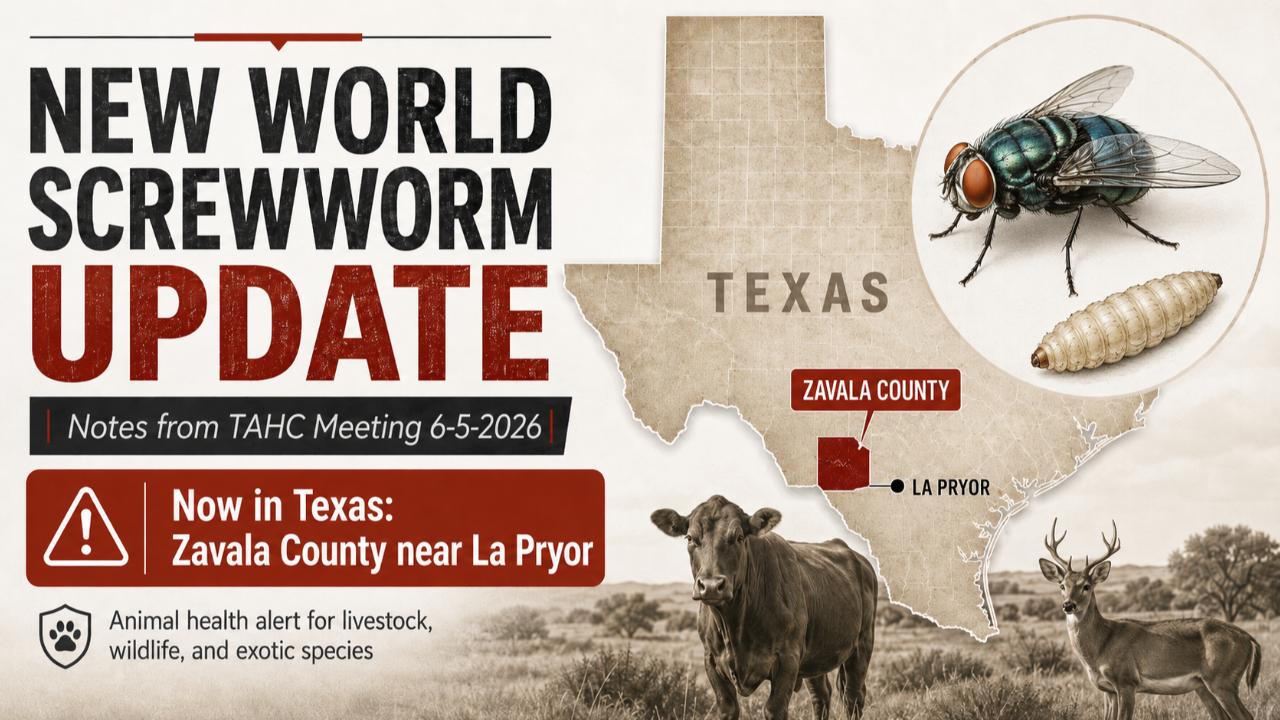
New World Screwworm = NWS
Date: June 5, 2026
Location Cotulla, TX – La Salle County
Sandra Leyendecker, DVM - TAHC
Raymundo Del Bosque
Judith Zaffirini - Senator
Leodoro Martinez – Judge La Salle County
Multiple Counties are signing Declarations of Disaster to get more help from local and federal governments.
Zaffirini
- House concurrent resolution 13
- Secured federal funding for NWS. 750 million in Edinburg, TX.
- Need to learn more.
- State of TX has been working to get FDA and EPA to expedite approval of relevant medications and pesticides.
Sandra Leyendecker
- Facts about NWS
- NWS is a blowfly that infests living tissue of warm-blooded animals
- Reportable disease (Legal responsibility to report to TAHC and USDA.)
- How did NWS travel
- Fly Flies 6-12 miles
- Humans moving animals is one of the biggest factors in spreading flies.
- Birds do not appear to be a major source of spread. They do not usually fly when they are infested.
- Life cycle
- Entire life cycle is 21 days
- Male and female fly mate. The female can only mate one time.
- 3200 eggs in lifetime. 300 eggs in a single wound.
- The male can mate with many females.
- If the male is sterile and he mates with the female, the females eggs will be sterile.
- This is the basis of the Sterile Fly Technique
- Most of the eggs hatch in 12 hours. In other words, maggots can be in the wound in 12 hours.
- There are 3 stage of larvae. It takes 1 week for a new larvae to pupate.
- It takes 1 week for a pupae to become an adult fly.
- Appearance
- Bright red/orange eyes. (Many flies have this)
- Metallic Blue/Green color with 3 lines on the back.
- There are other flies that can look like NWS. The
- Current infestations In Mexico – Source Senesica
- 26 Mexican state infested with 27,000 cases with 2077 active
- Minimal wildlife surveillance.
- 371 Human cases
- Cattle and Dogs are the most commonly affected.
- Sterile Fly production and distribution
- COPEG - Sterile flies are being only produced in Panama. That is currently the only facility in the world.
- Produces 100 million flies per week.
- In the 1960s, they produced more than 700 million flies.
- Mexico
- Currently it is only a distribution facility.
- Tampico, MX
- Estimated to be operational in early 2027
- Goal is to produce 100 million flies per week.
- USA
- Not expected to be online until 2028 to produce sterile flies.
- Currently it is only a distribution facility.
- Historically, the flies have been 50:50 male:female
- There is a new technique that is showing promise at producing 100% males.
- Goal is to produce 500 million flies per week.
- Once all of the planned facilites are online, they will produce an estimated 500 million flies. This is a significant shortfall from the number that was used in the 60’s
- Blacklight ID of sterile flies.
- Orange – Tampico
- Green – Moorefield
- Can help ID sterile flies.
- Ground release vs air release of sterile flies.
- There are trailers that they are using to release flies
- The sterile flies still behave the same as the reproductive flies. The key is the sterile flies lay eggs that do not hatch.
- Traps are made of 6 in PVC with a sticky substance with a specific “Stormlure” that was developed in Kerrville. The stormlure they are using is not available to the public.
- Some people have claimed that creating our own traps with stormlure will solve the problem. This is not the answer. This is best used as a surveillance tool. This will trap sterile flies too.
- COPEG - Sterile flies are being only produced in Panama. That is currently the only facility in the world.
- NWS and Wounds
- Very painful wound.
- Maggots feeding on living tissue with Egg packets around the wound.
- Wounds can be as small as an injection site or tick bite
- Very foul odor. The smell is a huge giveaway.
- Top Causes of NWS Myiasis in outdoor animals
- Umbilicus - Infants
- Cuts
- Wire cut
- Ear tag – Can eat the whole ear, skin, cartilage
- Castration
- Dehorning
- Dog bite
- Peeling skin
- Tick bite
- Prepuce
- Dogs
- Ear infections – Ear mites
- Scratching wounds
- Dog bites
- NWS has been shown to eat, muscle, skin, bone, cartilage
- NWS Prevention
- Routinely inspect animals
- Prevent Wounds.
- Treat navels with iodine to help them dry up
- SWAT / Catron / F10
- Treat and cover wounds promptly
- Try to get cows to calve in colder months.
- Treat clothing, gear, and people
- Perform procedures resulting in open wounds during cooler months.
- Immediately report all cases of suspected NWS
- DO NOT MOVE THE ANIMAL that is infested.
- NWS Treatments
- No drug all by itself is 100% effect at stopping NWS.
- Permethrin Insecticides
- Catron IV
- Cause the maggots to pop out quickly. You need to have a tarp or bag under the wound to prevent the larvae from getting on the ground. This can allow them to live in the ground until they pupate.
- F10 Pesticide and antiseptic
- 30 day meat withdrawal
- 10 day milk withdrawal
- Weekly dosing or as needed.
- Negasunt Powder
- Apply every 2-3 days
- The ointments seem to last longer
- Dectomax
- 48 hours to effect
- Prevention up to 21 days. Starts to taper effectiveness at 21 days.
- 35 day withdrawal
- Give SQ in all animals
- Dose = 1cc per 110lbs
- In her opinion, this works as a single option.
- Exzolt Cattle CA-1
- Furalaner – Same medicine that is in Bravecto for dogs and cats.
- Prevention up to 14 days. It is possible that it functions longer than that.
- Do not use in cattle in breeder bulls over 1yr. Do not use in calves under 2 mo.
- 98 day withdrawal.
- Prescription only.
- Ivermectin
- Used for prevention but not treatment.
- Only kills stage 1 larvae (Does not kill older maggots or flies)
- It has been proven that there are strains of NWS flies that are resistant to ivermectin.
- Dog and Cat – Credelio, Bravecto, Nexgard
- Malathion
- Ground Treatment
- Organophosphate
- Do not get it on your skin.
- Tanidil
- Topical powder
- Overuse and indescriminat use of dewormers like ivermectin can cause intestinal parasite resistance. This could ultimately prove to be catastrophic.
- NWS Response
- Infested zone
- La Pryor = center
- Spans 12 miles from the center
- Do not move animals out of the area without an inspection. IOW, Animals can move from the infested zone with a TAHC inspection.
- Surveillance zone
- Spans about 20 miles from La Pryor
- Placing traps for increased monitoring
- Releasing sterile flies in Zavala
- Infested zone
- Key Points
- Inf NWS is detected on the property, the property will be placed under quarantine
- The size of the area and number of infestations will determine how large the quarantine area is.
- Keep records for animals to improve traceability.
- Collecting samples
- Gloves
- 70% isopropyl alcohol
- Forceps or tweezers to remove larvae
- Any screwcap vial to contain the maggots
- Tape the vial shut
- Notify TAHC
- All reported cases with get a foreign animal disease number.
- Process to remove larvae
- Be gentle so you don’t distort the insect.
- Collect larvae from the deepest part of the wound. Collect larvae of all sizes.
- Remove all maggots to prevent spread
- Place maggots in alcohol
- Carcass Disposal
- Best way is burning – With approval if needed.
- Freeze the animal if you want it to get examined/necropsy
- Deep burial – at least 4 feet in tightly packed soil. Least preferred method. Place Lime on the carcass on the carcass.
- If you choose not to report NWS to the state or feds
- You open the door to spreading NWS
- You show disregard for your neighbor, state, and country.
- You delay stopping the spread of NWS.
- The situation gets worse.
- A person who fails to report can be subject to $5,000 / Day in addition to criminal penalties and sanctions, civil remedies
- NWS is not like Cattle Fever Tick it can spread fast and fly.
- Only Sterile Flies can stop NWS. We cannot out medicate, out treat, or outspend NWS.
Eric Garza – TPWD Biologist – Discussing Wildlife
- Place game cameras at strategic locations
- His cell phone 512-753-2707
- Use if you need to find a local biologist
- Every county has a TPWD biologist assigned to the county.
- There is not a medication that is labeled for use in wildlife unless they are captive.
Questions and Discussion
- Universal sentiments of fear and concern.
- The citizens frustrated with the USDA on the response. The USDA has had roughly 2 years to prepare for this. Everyone thought NWS would be in the USA last summer, but it didn’t end up making its way in the US at that time which kicked the can down the road roughly a year. This gave us more time to prepare. So far, fly production hasn’t made much progress on increasing production in the 2 years the USDA has had to prepare. They are still building facilities, but those are not expected to come online for another 1 to 2 years.
- The citizens want the USDA to allow the private sector to do fly production in conjunction with the feds so it can be done faster.
My Opinions:
- The USDA is moving WAY to slowly. Talking about this plan or that plan. This ribbon cutting or that facility opening. We need flies. We need less discussion and more flies. We cannot out-treat, out-medicate, out-monitor, out-trap, or out-spend the NWS. We simply need more flies. The USDA either needs to produce more flies or get out of the way and let the private sector get the job done.
- Personally here are the meds I am going to use. This list is only what I will use for NWS cases and to prevent NWS. This is not all I will do for wounds.
- Pesticide (Kill the larvae)
- Catron IV
- F10 antiseptic and pesticide (Ointment and Spray)
- Dectomax (Topical and Injectable)
- Exzolt (Topical -> oral)
- Pesticide (Kill the Fly on and around the animal)
- Co-Ral
- Permectrin 2
- Pesticide (Kill the larvae)
Stay connected with news and updates!
Join our mailing list to receive the latest news and updates from our team.
Don't worry, your information will not be shared.
We hate SPAM. We will never sell your information, for any reason.
